
Our News ENERTECH News
-
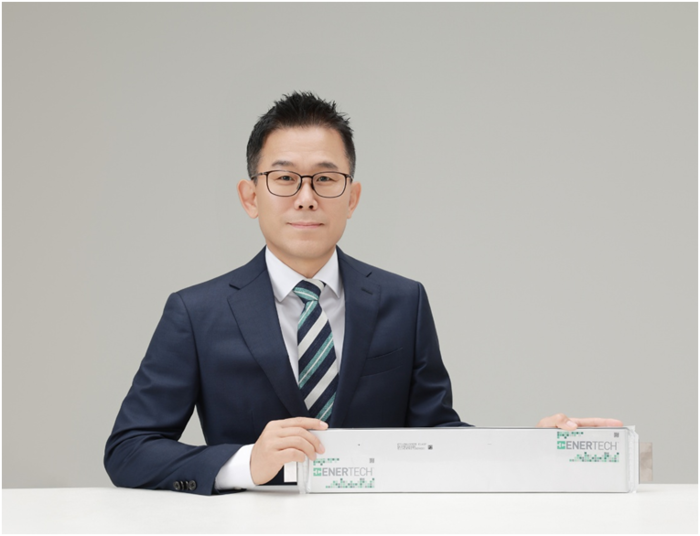
Enertech Develops Sodium-Ion Battery…“Mass Production in 2027”
Enertech International is entering the rapidly emerging sodium-ion battery market, recognized as one of the most promising next-generation battery technologies. The company announced on the 1st that it has successfully developed a sodium-ion battery prototype with an energy density of 140–160 Wh/kg. Enertech plans to complete cell process stabilization and performance verification by the first half of next year and begin mass production in January 2027. Sodium-ion batteries use sodium instead of lithium, providing a distinct advantage in raw-material availability and cost competitiveness. They also offer low thermal-runaway risk, reduced capacity loss at low temperatures, and improved transport safety. Unlike lithium-ion batteries, which can suffer performance degradation when discharged below 30% state of charge (SoC), sodium-ion batteries can be fully discharged to 0% without issue, making them highly attractive for applications such as electric vehicles (EVs) and energy-storage systems (ESS). Enertech International is currently pursuing supply opportunities with overseas EV manufacturers. Mass production will begin at the company’s battery plant in Chungju, South Korea, and — after technology stabilization — manufacturing will be expanded to Enertech’s new European production site. Sang-Hyun Nam, Executive Vice President and Head of the R&D Center at Enertech International, stated: “Sodium-ion batteries can be manufactured on existing NCM (nickel–cobalt–manganese) production lines without additional investment,” adding that“since dedicated materials such as cathode materials are still required, we are conducting joint development with Korean and Chinese material suppliers.” Commercialization of sodium-ion batteries is currently accelerating in China, with CATL already mass-producing and supplying the technology to Chinese EV OEMs. In Korea, LG Energy Solution, Samsung SDI, and SK On remain in the R&D stage, positioning Enertech International’s plan for mass production in 2027 as a notable development in the industry. Founded in 2001 through a spin-off of the Saehan Group’s battery division, Enertech International aims to broaden its product portfolio with the addition of sodium-ion batteries. The company currently produces NCM batteries at its Chungju plant and is also developing lithium iron phosphate (LFP) batteries. Enertech expects to manufacture three battery chemistries — NCM, Sodium-ion, and LFP — by 2027. Nam concluded: “Sodium-ion batteries have significant potential to complement — or even replace — lithium-ion batteries,” emphasizing that“accelerating commercialization will enable us to strengthen our responsiveness in both the EV and ESS markets.”관리자
-

EnerTech International, Begins Development of LFP Batteries — “Targeting Mass Production in 2027”
EnerTech International has initiated development of lithium iron phosphate (LFP) batteries, with plans to begin full-scale mass production after 2027 to target the growing energy storage system (ESS) market. The company announced on the 13th that it has produced a prototype of a small-form-factor LFP cell and plans to complete development next year by scaling up the cell size. EnerTech International will expand its product portfolio from the currently mass-produced nickel-cobalt-manganese (NCM) batteries to LFP. Beginning in the first quarter of next year, the company will also start developing lithium manganese iron phosphate (LMFP) batteries, which add manganese to LFP to increase energy density. LMFP development is being prepared in collaboration with an overseas cathode-material manufacturer. “The demand for LFP batteries is rapidly increasing, especially for ESS applications, so it is critical for us to respond,” said Sang-Hyun Nam, Head of R&D at EnerTech International (Executive Director). “In addition to LFP, we also plan to diversify our lineup with the development of a high-voltage ‘NCM 613’ battery, containing 60% nickel.” The company’s flagship battery product is the “NCM 811,” consisting of 80% nickel, 10% cobalt, and 10% manganese. With its high nickel content, the NCM 811 maximizes energy density, thus extending electric-vehicle driving range. However, the high performance of NCM 811 also results in high cost. Alongside the temporary slowdown in EV demand (the “EV chasm”), cost competitiveness has become increasingly crucial, bringing mid-nickel and LFP batteries into the spotlight. While mid-nickel and LFP have lower energy density than high-nickel chemistries, they offer significant price advantages. LFP also provides excellent safety and long cycle life, driving strong demand in the ESS sector. EnerTech International plans to produce LFP cells at its new 2-GWh battery plant under construction in the Dong-Chungju Industrial Complex. The plant is scheduled for completion in 2027, with LFP development being finalized next year, followed by equipment installation and full-scale production ramp-up. In addition to its existing 1-GWh production facility in Chungju, the company is pursuing global expansion. EnerTech is building two battery plants in Europe with a combined production capacity of 8 GWh, and another 6-GWh facility in South Africa. By 2028, the company’s total global production capacity is expected to reach 17 GWh. Founded in 2001 as a spin-off from the battery division of Saehan Group, EnerTech International manufactures lithium-ion batteries for electric buses, trucks, and hybrid vehicles. Its major domestic and global customers include Hyundai Motor Company, Ford, LG Energy Solution, and Komatsu. “We will continue to secure growth momentum by ensuring timely development and capacity expansion to respond to the battery market rebound following the EV chasm,” Nam emphasized.관리자
-
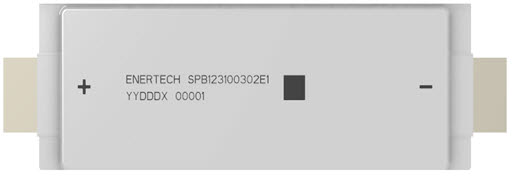
Enertech invests KRW 35 billion in factory expansion in 2023
Enertech International (Enertech / ETI) will invest KRW 35 billion in the expansion of secondary battery plants. Through expansion, the production scale will be more than tripled.Founded in 2001, Enertech produces secondary batteries for electric vehicles and energy storage systems (ESS). The current production scale is 150MWh. Enertech will expand its factory to close the technology gap with the three major domestic battery companies and lay the foundation for growth. Investment is to expand its production capacity to 500MWh next year.The expansion line produces more than 3 million 60Ah battery cells per year. It has a nickel-cobalt-manganese ratio of 8:1:1. Both secondary batteries and ESS can be applied, and test discussions are underway with customers. Enertech expects to be able to acquire new customers in Korea and the United States through the expansion.Enertech also invests in building for module and pack assembly automation lines. Three modular automated assembly lines and one pack assembly line will be put into operation in May next year. Enertech aims to enter the module and pack assembly business for electric vehicles after 2024 through the construction of an automation line.Enertech has also developed special-purpose lithium iron phosphate (LFP) cells and hybrid vehicle (HEV) cells, and have acquired customers in the development stage.Enertech official said, "ETI is aiming to supply the products produced by the new module and pack assembly line to domestic and foreign automakers," adding, "ETI will continue to invest in a virtuous cycle factory operation structure centered on the cells produced through expansion."Enertech International researcher examines batteries at the research center관리자
-

Accelerating EV battery development
Enertech plans to introduce a new model, the VDA cell, in the second half of 2022.The VDA model provides a useful size for EV batteries by minimizing space consumption when configured as a pack with low and long battery cell type.The cell development is scheduled to be completed in the second half of 2022, and the production of this VDA model is the reason for the plant jointly established by Renera-Enertech, a Russian subsidiary, and Rosatom, Russia.Enertech, which has been recognized for its safety and quality, is already carrying out projects with major customers with the goal of commercializing electric vehicles in Russia immediately following the completion of the factory establishment.Enertech's Existing heavy duty truck, two-wheeled vehicles, and bus customers and new models are also under review, and plant expansion is already being considered in Korea.admin
-

Enertech to apply 'silicone anode material' for the first time to electric bike batteries
Enertech International and Enervate, a battery-based startup in the United States, are pushing to install a battery based on a silicon anode material in electric motorbikes. Silicon anode material is considered as a new next-generation battery material that speeds up battery charging and increases energy capacity. Enertech plans to supply batteries with silicon anode materials from next year.According to the industry on the 14th, Enertech International plans to supply batteries with silicon anode material to Italian motorbike makers next year.Silicon anode material shortens battery charging time and increases energy density. It is attracting attention as a next-generation battery material because its energy density is 10 times higher than that of existing graphite-based anode materials. According to the industry, the silicon anode material market is expected to grow to 5.5 trillion won in 2025.The silicon anode material is supplied by Enervate of the US, and the battery is manufactured by Enertech. Enertech plans to apply Enervate silicon anode material to high-nickel 'NCM (nickel, cobalt, manganese)' batteries to be installed in electric bikes scheduled to be released in the second half of next year.An Enertech official said, "Battery with a silicon anode material will be able to charge as fast as the refueling time of an internal combustion engine vehicle and realize high energy density."This is the first time that Enertech has applied a silicon anode material to an NCM battery. Although silicon anode material enhances battery performance, it is known to be supplied to the premium electric motor market because it can increase the battery manufacturing cost.Enertech plans to expand the application of silicon anode material to premium electric vehicles as well as electric bikes. LG Energy Solutions applied silicon anode material to the premium electric vehicle brand Taycan, which was first launched by Porsche in 2019.Deok-geun Oh, CEO of Enertech, said, "We will speed up battery development to meet customer needs by combining Enertech's NCM battery manufacturing technology and Enervate's silicon anode material technology."Enervate CEO Robert Lango said, "Silicone anode material will be able to improve battery fast charging and energy density."[www.etnews.com/20210614000102]admin
-

Enertech challenges to commercialize LFP batteries for electric vehicles
Domestic battery specialists have joined forces to develop lithium iron phosphate (LFP) batteries for electric vehicles, drawing attention. LFP is evaluated as a battery with good safety and low price. However, in the meantime, there are few places that manufacture it in Korea, and it has only been used for special purposes. However, interest in LFP batteries has increased as battery cost reduction has become a hot topic in the electric vehicle era.According to the industry on the 24th, Energy Materials and Enertech International started to develop LFP batteries with the goal of mounting electric vehicle batteries. Energy Materials is in charge of the LFP cathode material, and Enertech International plans to make a finished battery for electric vehicles based on the cathode material.LFP was mainly driven by Chinese battery makers. However, LFP batteries have recently been attracting attention again. In order to advance the era of electric vehicles, the price of batteries must also be lowered, and LFP is emerging as a suitable battery for the popularization of electric vehicles.In addition, in the case of LFMP batteries with manganese added to LFP, it is known that the battery performance can be strengthened while maintaining safety at a low price, so the growth potential of the LFP battery market is increasing.Energy Materials and Enertech International are currently in the development stage, so it remains to be seen whether the final commercialization will be made, but expectations are high on the outcome as it is a collaboration between the only LFP cathode material company in Korea and a professional company with a history of supplying batteries to electric vehicles and electric buses. there is.An Energy Materials official said, "We are promoting the development of cathode materials that compensate for product performance problems while maintaining the low price and safety of LFP batteries.[www.etnews.com/20210524000100]admin
-

New Enertech battery of NCM 811
1. Gen4 EV Specification 1) Gen 4 EV cell increased the capacity by 17% (5Ah) from the existing Gen 3 EV cell by applying Nickel-rich(NCM811) cathode active material. - Gen3 EV : 25Ah - Gen4 EV : 30Ah 2) Operation at Low Temp and high output characteristics are equivalent to Gen 3 EV cell. 2. Gen4 EV development plan 1) Gen4 EV cell development is to be completed and will be ready for PO from Q2 in 2021admin
-

Enertech battery on Incheon Monorail
Korea's longest urban tourist monorail has started running again.The Monorail with 14.4 Km/h of speed was built with the cells & sub-packs supplied by Enertech International, Inc. based on pure domestic technology and praised for its outstanding safety features. The battery, capacity range from 6 Kwh to 27 Kwh, has been selected as a suitable solution for the monorail business that was likely to be discontinued due to safety issues before.The solution of Monorail in Incheon proved its quality of the battery and Enertech will be playing a key role starting from Incheon city to nationwide as the business grows.admin
-

Thin NCM (Nickel-Rich) cathode electrodes for a high-energy density
Sion Power Corporation: Enertech and Sion Power entered into a supply agreement for the thin NCM(Nickel-Rich) cathode electrodes for a high-energy density Lithium Metal Cell (500Wh/kg, 1,000Wh/L) for UAV (Unmanned Vehicle System) and high altitude pseudo-satellite.Sion Power is a leading developer of lithium battery technology and announced that the ground breaking of a new battery test facility will be built by April 2019 and the new facility will encompass over 5,300 square feet and will include more than 3,000 cell test channels at Tucson, AZ on April, 2019.admin